


Uncategorized
5 Habits that may SAVE your back
5 Habits that may SAVE your back

Protecting your back does not need a lot of time and energy. Instead, by applying simple measures into your daily activities, you can achieve significant changes in your posture and overall well-being. These habits can help reduce back pain, improve musculoskeletal health, and enhance productivity.
Habit 1:
In the morning, your inter-vertebral discs are more vulnerable and need to be protected, mainly from slouching. In general, you want to avoid slouching and any slouched posture during the early hours of the day.
This means;
1 – Standing instead of sitting during breakfast
2 – Postpone sitting while taking public transport until you absolutely need to.
Habit 2:
Alternating between unhealthy postures* does not make you healthy. Adapting your body and activities to healthy postures and alternating between them should be your goal to reduce back pain.
*To better recognize healthy from unhealthy postures, watch this video on the 3+1 Rules of Posture: Here, I explain why.
- The back should neither be slouched, nor slumped, nor hollow nor twisted
- The neck needs to remain as relaxed as possible
- Posture is built upwards
- Joints are not meant to bear excessive pressure.
To cut a long story short, here is what you can already do:
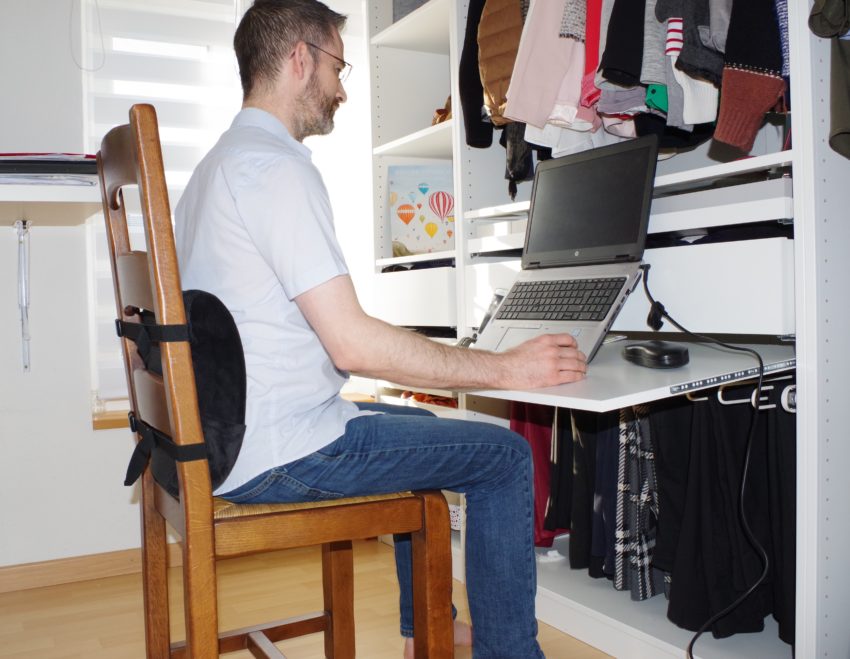
- If you work sitting:
- Park your car at far from the entrance as you can (more steps and movement)
- Get off the bus at one stop earlier (for the same reasons)
- Take your breaks or have your coffee standing instead of on your chair.
- If you work standing:
- Rest your belt (i.e. the pelvis) against the wall as soon as you can
- Use the military technique when standing in one spot (find my tutorial here )
- In situations where you can, walk instead of standing still.
Habit 3:
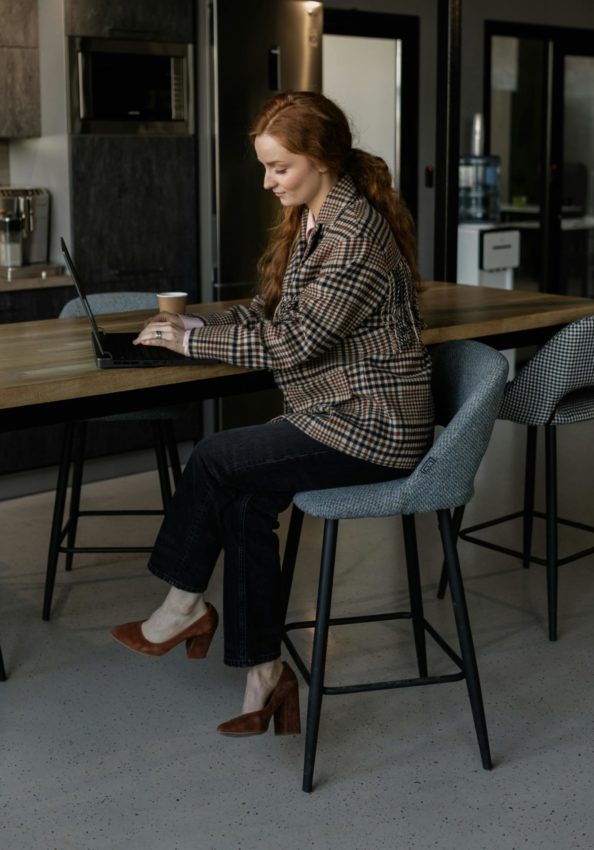
Rest your pelvis against the lumbar support whenever you sit. If your chair has no lumbar support, try to create one with your coat, bag or a cushion if available. Supporting your lower back is essential for maintaining a healthy posture throughout the day, as well as reducing overall back pain.
Habit 4:
Muscle tension is an exponential phenomenon and you need frequency to prevent it from building up.
You can use the upper body reset to do this as I have found it to be the most effective tool from my patients. Watch the tutorial on the Upper Body Reset here to learn this simple, effective technique.
Habit 5:
A simple, easy and effective stretch before bed or falling asleep – bring your knees towards your chest and hold it for a minute or two. This stretch is a great way to unwind and prepare your entire body, and not just your back, for restful sleep.
Conclusion:
Now because these are habits we are talking about here, you are not going to see immediate results. Just like it took time to see the negative effect of bad habits, it will take your body some time to see the benefits of adding these habits to your daily routine.
Although, I do have something that can help you, or rather help you help yourself. I have developed a free self assessment tool that covers most of the variables affecting your workstation and seated posture. As I said, this is a 100% free self-assessment tool aimed at making your life less painful and your office hours more sustainable – so please, give it a try and share it with colleagues who also experience posture related pain or discomfort at their workstations – https://ergoh-conseil.typeform.com/self-assessment
A new pain management tool
Discover Box 3 and its applet: they allow you to take back control of your...
5 Habits that may SAVE your back
Simple things that you can do TODAY to feel better.
Ergonomics for dentistry
Discover Olivier's FREE 1hr course for dental professionals, created with Admetec.


The ErgOHListic Method
The ErgOHListic Method is now a registered trademark! Here is why we took this new...


The NUMEE Lab – for free!
Discover Olivier's ergonomic webinars - for FREE!